Trusted by teams at

 paladir






 paladir
Your assistants write code at machine speed. Xora attacks it at machine speed, then brings findings back to your editor.
Third-party research, linked in full below.
Trusted by teams at
paladirpaladirAI code security is the practice of finding and fixing vulnerabilities in code written by AI coding assistants. That code can carry the same flaws as human-written code, such as injection and broken access control. It also arrives quickly, often faster than a team can review it line by line. Xora tests the application you deploy, whoever wrote the code.
When an assistant writes a feature in an afternoon, security review gets squeezed, and the research says that code needs more review, not less. CodeRabbit found up to 2.74x more security issues in AI-co-authored pull requests than in human-only ones (470 open-source PRs, December 2025). Veracode found a security flaw in 45% of AI coding tasks, rising to 72% in Java (2025 GenAI Code Security Report). In Fortune 50 codebases, Apiiro saw privilege escalation paths rise 322% as AI coding took hold (September 2025). Testing every deploy keeps pace, and a CI release gate stops a build when Xora proves an exploit.
Whether a person or an assistant wrote the change.
Xora reads your source code and attacks your staging environment after each deploy.
With --block-on-exploit in your pipeline, a proven exploit stops the release before production.
The Xora MCP server gives your editor's agent the vulnerable code, evidence and remediation guidance.
I was incredibly impressed and surprised how quickly Xora was able to add value. I don't have to hire an additional app sec engineer to find my vulnerabilities, Xora gives that to me. We can now do more with less.
Every finding is labelled by how it was confirmed, so the team knows which issues to fix before the next release. Developers get the file and line for each one; see pentesting for engineering teams.
| Compared | Xora | Code review | SAST tool |
|---|---|---|---|
| Keeps pace with assistant output | Tests every deploy | Limited by reviewer time | Yes |
| Attacks the running app | Yes | No | No |
| Proves the exploit | Yes, with the request and response | No | No |
| Findings in your editor | Yes, through MCP | In the pull request | Some tools |
| Can stop a release | Yes, from CI | Yes, by not approving | Yes, on a rule match |
Yes. Vibe coding, building by prompting an assistant, ships code nobody reviewed line by line. Xora tests the deployed result the same way it tests any other change.
Often, yes. CodeRabbit's December 2025 study of 470 open-source pull requests found up to 2.74x more security issues in AI-co-authored changes. Veracode's 2025 GenAI Code Security Report found a security flaw in 45% of AI coding tasks, and 72% in Java.
No, and it doesn't need to. Xora tests the application you deploy, so every change is covered the same way.
Claude Code, Cursor, or any MCP-capable editor. The server is read-only and scoped to the repository you have open; setup is on the integrations page.
Yes. Xora is whitebox and requires source code access.
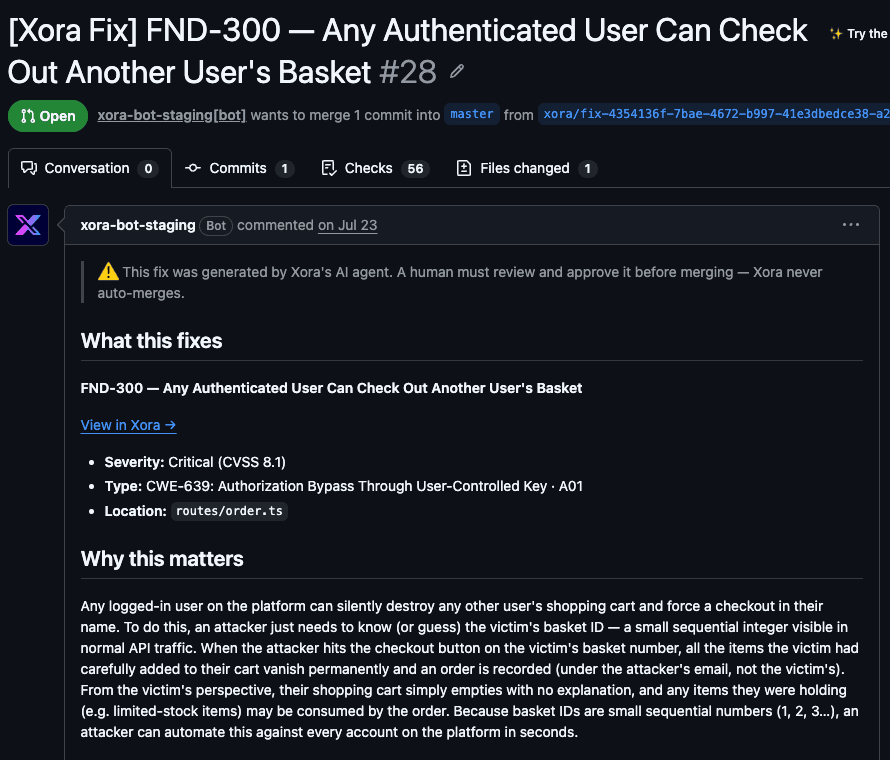
Yes. For web and API findings, generate a patch and Xora opens a fix pull request on GitHub, Bitbucket or Azure DevOps. The Xora MCP (Model Context Protocol) server also brings each finding's evidence and remediation guidance into Claude Code, Cursor or any MCP-capable editor, so your coding assistant can help write the fix.
We ran Xora against OWASP Juice Shop, a deliberately vulnerable practice app, and wrote up the findings, evidence, severity and remediation guidance.
Enter your email and we'll send you the PDF. No sales call required to see it.
