Trusted by teams at

 paladir






 paladir
Xora maps your API from the source code, then tests what each user, role and tenant can reach.
Measured across Xora customers, November 2026.
Trusted by teams at
paladirpaladirAPI security testing checks an application programming interface (API) for exploitable weaknesses. The OWASP API Security Top 10 lists the main risks, led by broken object-level authorization, broken authentication and server-side request forgery. Testing should cover REST and GraphQL endpoints, including undocumented ones. Xora finds routes in your source code and specs, then tests each role's access.
API tests usually start from whatever spec someone exported, so forgotten routes go untested. Xora builds the route list from the code itself. Your front end gets the same treatment in web application penetration testing.
From your source code, OpenAPI and Swagger specs, and front-end bundles, including undocumented ones.
GraphQL endpoints are found and mapped through introspection, then tested alongside REST.
Users, roles and tenants. Headless backends sign in through the API's own login endpoint.
Xora checks for broken object-level authorization (BOLA, also called IDOR) and data leaking between tenants.
Xora was able to surface exploits that should've been caught by our previous pentesters, but weren't. The landscape has changed so much, autonomous pentesting is the future.
No login page needed, so the API behind a mobile app gets tested too. If that app is on Android, see mobile app penetration testing. Findings link to their CWE and OWASP entries.
| Compared | Xora | Spec-based API scanner | Annual manual pentest |
|---|---|---|---|
| Finds routes from | Source code, specs and bundles | The spec you upload | The docs in scope |
| Undocumented routes | Found in the code | Missed unless in the spec | If the tester finds them |
| Signs in as | Each user, role and tenant | Usually one token | The roles in scope |
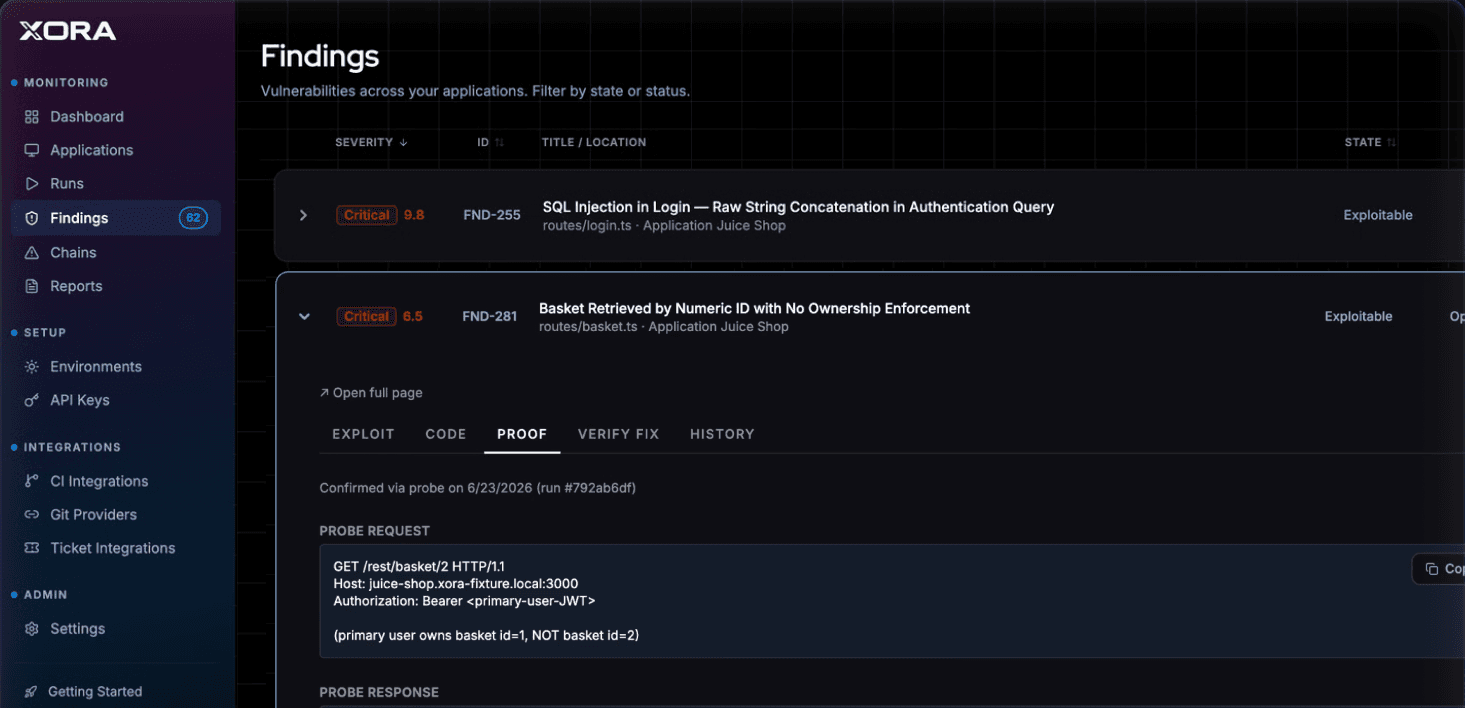
| Proves the exploit | Yes, with the request and response | No, flags likely issues | Yes |
| Retests | Unlimited, included | Rescan | Often quoted separately |
Yes. API penetration testing is the hands-on part of API security testing: attacking the API to show which weaknesses are exploitable. Xora does both, and proves findings with the request and response.
No. A spec helps, but Xora also finds routes in your source code and front-end bundles.
REST and GraphQL. Tell us if your API uses something else and we'll say plainly whether Xora covers it.
Yes. Xora is whitebox and requires source code access; that is how it finds routes no spec lists.
We ran Xora against OWASP Juice Shop, a deliberately vulnerable app with a REST API, and wrote up the findings, evidence, severity and remediation guidance.
Enter your email and we'll send you the PDF. No sales call required to see it.
