Trusted by teams at

 paladir






 paladir
Xora signs in as each of your user roles and attacks what each one can reach behind the login.
Measured across Xora customers, November 2026.
Trusted by teams at
paladirpaladirWeb application penetration testing is a simulated attack on a web application to find vulnerabilities an attacker could exploit, such as injection, broken access control and authentication flaws. A thorough test signs in as real users to reach pages and data behind the login. Xora signs in as each of your user roles, including through single sign-on (SSO).
A test that can't sign in only sees your login form. The serious findings, like one customer reading another's data, need a session for each role. The APIs behind the app get the same treatment; see API security testing.
Xora maps routes from your source and JavaScript bundles, including calls a single-page app makes in the background.
An AI browser agent logs in through Entra, Okta, Google, Auth0, OneLogin or WorkOS, MFA codes included.
It tests what each role can reach, and links bugs into multi-step attack chains.
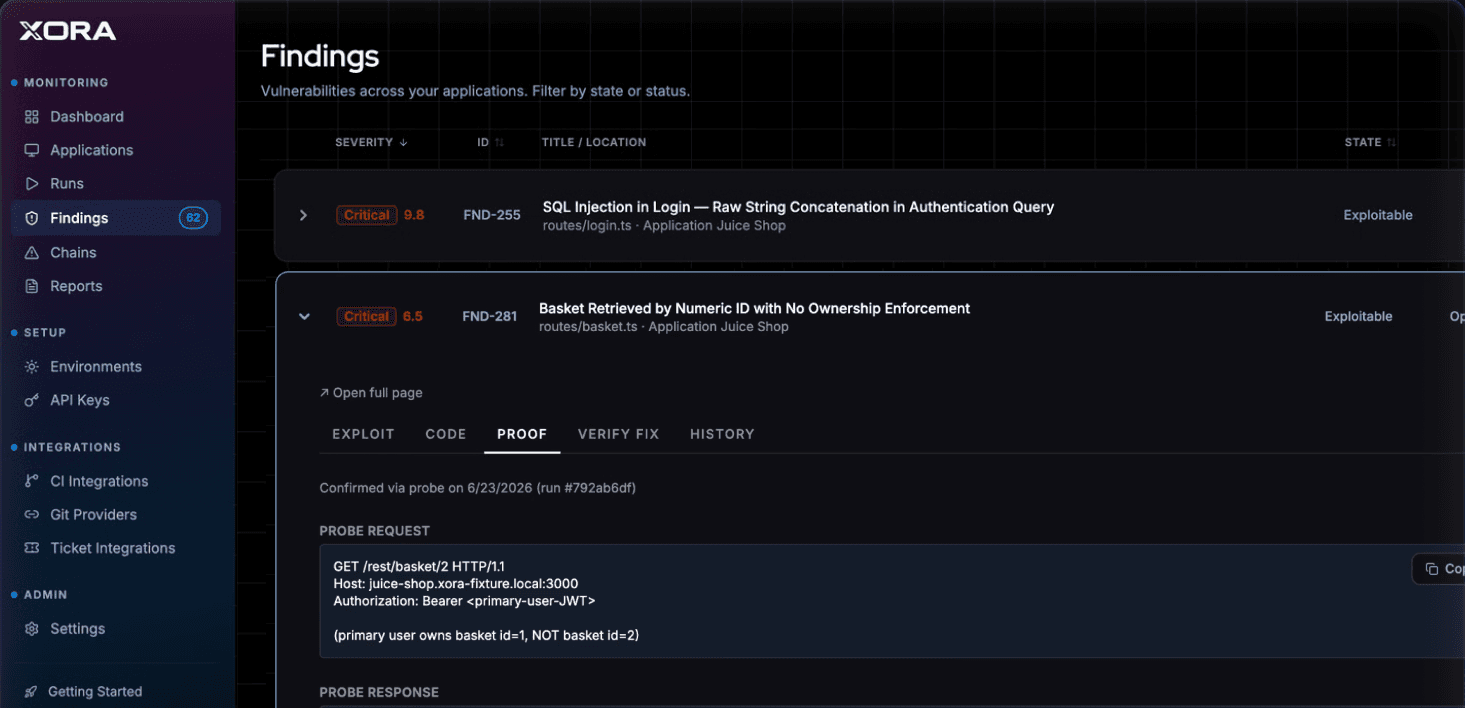
Every finding carries its proof. Retest a fix as often as you like.
Xora was able to surface exploits that should've been caught by our previous pentesters, but weren't. The landscape has changed so much, autonomous pentesting is the future.
Because it starts from your code, Xora finds the routes a crawler never sees. That is what white box penetration testing adds. Run it on every deploy with continuous penetration testing.
| Compared | Xora | Annual manual pentest | DAST scanner |
|---|---|---|---|
| How often | Every deploy | Once or twice a year | On a schedule |
| Signs in as | Every role, through SSO | The roles in scope | Usually one recorded login |
| Reads your source code | Yes | Rarely | No |
| Proves the exploit | Yes, with the request and response | Yes | No, flags likely issues |
| Retests | Unlimited, included | Often quoted separately | Rescan |
| First results | Median 10 minutes | Weeks after kickoff | Minutes |
Username and password, SSO through Microsoft Entra, Okta, Google, Auth0, OneLogin or WorkOS, plus authenticator-app and texted codes. Tell us about anything else your login needs.
No. Xora tests your staging or pre-production environment, with test data.
Yes. Xora is whitebox and requires source code access; it is how routes behind the login get found.
We ran Xora against OWASP Juice Shop, a deliberately vulnerable web app, and wrote up the findings, evidence, severity and remediation guidance.
Enter your email and we'll send you the PDF. No sales call required to see it.
