Trusted by teams at

 paladir






 paladir
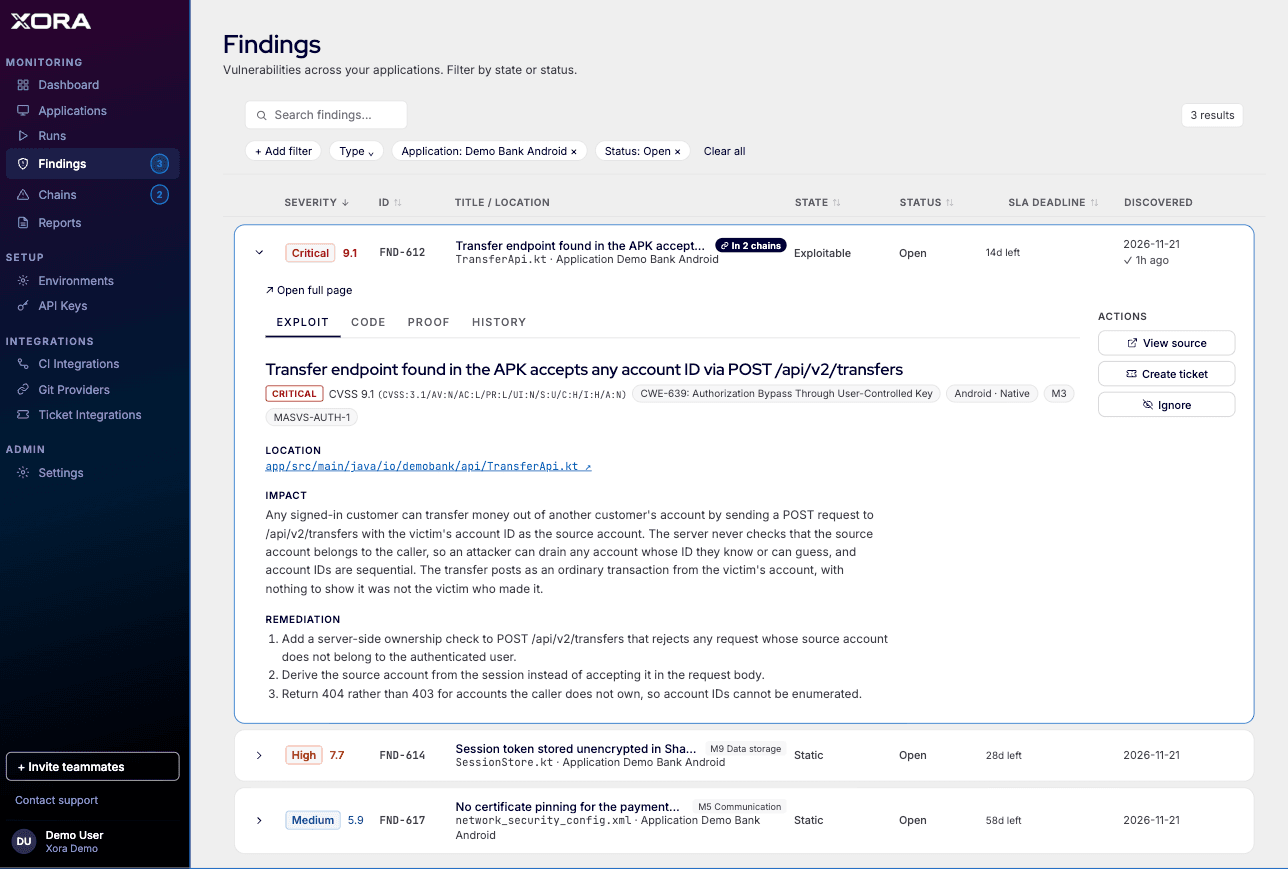
Xora reviews your Android app's source code and release APK together, and maps every finding to OWASP MASVS.
Trusted by teams at
paladirpaladirMobile application penetration testing looks for vulnerabilities an attacker could exploit in a mobile app. It covers the app's code, the data it stores on the device, its network traffic and the APIs it calls. Xora tests Android apps from their source code and, when you upload one, the release APK, mapping each finding to OWASP MASVS.
Mobile apps ship secrets, storage and network settings that a web pentest never looks at, and the release build can differ from the code you reviewed. Mobile findings belong in the same evidence as the rest of your application, including your SOC 2 pentest.
Add your mobile repository to the same application as its backend.
Run xora apk upload with your release build.
Native Kotlin and Java, Kotlin Multiplatform, React Native (bare and Expo), Flutter and Capacitor.
Each finding gets an OWASP Mobile Top 10 category and MASVS control, then lands in Jira or Linear.
Xora was able to surface exploits that should've been caught by our previous pentesters, but weren't. The landscape has changed so much, autonomous pentesting is the future.
Mobile and API findings sit side by side in one report, each with the file and line it traces to; see pentesting for engineering teams.
| Compared | Xora | Web app pentest | APK-only scanner |
|---|---|---|---|
| Reviews the app's source | Yes | No | No |
| Reads the release APK | Yes | No | Yes |
| Storage and network settings | Yes | No | Yes |
| Mapped to OWASP MASVS | Every finding | No | Varies |
| Mobile and backend in one report | Yes | Backend only | App only |
Yes. Mobile app security testing covers the app's code, the data it stores, its network settings and the APIs it calls. Xora reviews Android source and the release APK, and tests the backend API in the same application.
Native Kotlin and Java, Kotlin Multiplatform, React Native (bare and Expo), Flutter and Capacitor.
Add your mobile repository to the same application as its backend, and upload a release APK with xora apk upload.
iOS apps aren't covered yet, and Xora doesn't test on a device or an emulator. Testing reads your source code and release APK.
We ran Xora against OWASP Juice Shop, a deliberately vulnerable practice app, and wrote up the findings, evidence, severity and remediation guidance.
Enter your email and we'll send you the PDF. No sales call required to see it.
