Trusted by teams at

 paladir






 paladir
Xora reads your source code, works out how your app can be attacked, then attacks your staging environment.
Measured across Xora customers, November 2026.
Trusted by teams at
paladirpaladirAutomated penetration testing uses software to find vulnerabilities in an application and attempt to exploit them, the work a human pentester does by hand. It runs on demand or on a schedule and returns results within hours. Xora's automated tests read your source code first, then attack your staging environment to show what is exploitable.
The report arrives after the code has moved on. Automated testing runs whenever you need it, so you test before a release, not after. For a test on every deploy, see continuous penetration testing.
Xora uses your source code to find routes, inputs and the logic an outside scanner can't see.
AI agents attack your staging environment, signed in as each of your roles.
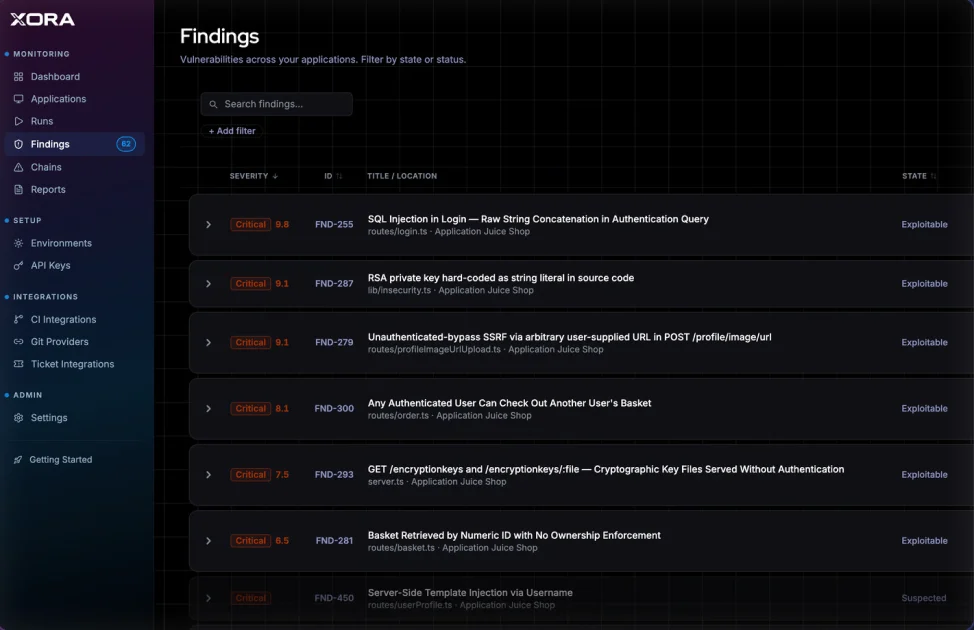
Xora tries to exploit each finding first, and labels every finding by how it was confirmed.
Retests are unlimited. For an exploited finding, the retest replays the exploit.
Walk the real product: filter findings by how they were confirmed, open one an agent proved exploitable, and watch a fix get verified.
Xora was able to surface exploits that should've been caught by our previous pentesters, but weren't. The landscape has changed so much, autonomous pentesting is the future.
Starting from the code, Xora aims its attacks at the paths that matter in your application. The attacks are run by AI agents; read more about AI penetration testing.
| Compared | Xora | Annual manual pentest | DAST scanner |
|---|---|---|---|
| When it runs | Whenever you need it | Booked in advance | On a schedule |
| Reads your source code | Yes | Rarely | No |
| Proves the exploit | Yes, with the request and response | Yes | No, flags likely issues |
| First results | Median 10 minutes | Weeks after kickoff | Minutes |
| Retests | Unlimited, included | Often quoted separately | Rescan |
For many teams, the formal report covers what the annual pentest was for. Some requirements still call for a human-led test; tell us yours and we'll say plainly whether Xora covers it.
Yes. Xora is whitebox and requires source code access. That is where its depth comes from.
No. Xora tests your staging or pre-production environment.
As often as you fix. Retests are unlimited and included. For a finding Xora exploited, the retest replays the exploit against your staging environment as soon as the fix is deployed.
We ran Xora against OWASP Juice Shop, a deliberately vulnerable practice app, and wrote up the findings, evidence, severity and remediation guidance.
Enter your email and we'll send you the PDF. No sales call required to see it.
